How Large Language Models work
- 5 min read
Thanks to Large Language Models (or LLMs for short), Artificial Intelligence has now caught the attention of pretty much everyone. ChatGPT, possibly the most famous LLM, has immediately skyrocketed in popularity due to the fact that natural language is such a, well, natural interface that has made the recent breakthroughs in Artificial Intelligence accessible to everyone. Nevertheless, how LLMs work is still less commonly understood, unless you are a Data Scientist or in another AI-related role. In this article, I will try to change that.
Admittedly, that’s an ambitious goal. After all, the powerful LLMs we have today are a culmination of decades of research in AI. Unfortunately, most articles covering them are one of two kinds: They are either very technical and assume a lot of prior knowledge, or they are so trivial that you don’t end up knowing more than before.
This article is meant to strike a balance between these two approaches. Or actually let me rephrase that, it’s meant to take you from zero all the way through to how LLMs are trained and why they work so impressively well. We’ll do this by picking up just all the relevant pieces along the way.
This is not going to be a deep dive into all the nitty-gritty details, so we’ll rely on intuition here rather than on math, and on visuals as much as possible. But as you’ll see, while certainly being a very complex topic in the details, the main mechanisms underlying LLMs are very intuitive, and that alone will get us very far here.
This article should also help you get more out of using LLMs like ChatGPT. In fact, we will learn some of the neat tricks that you can apply to increase the chances of a useful response. Or as Andrei Karparthy, a well-known AI researcher and engineer, recently and pointedly said: “English is the hottest new programming language.”
But first, let’s try to understand where LLMs fit in the world of Artificial Intelligence.
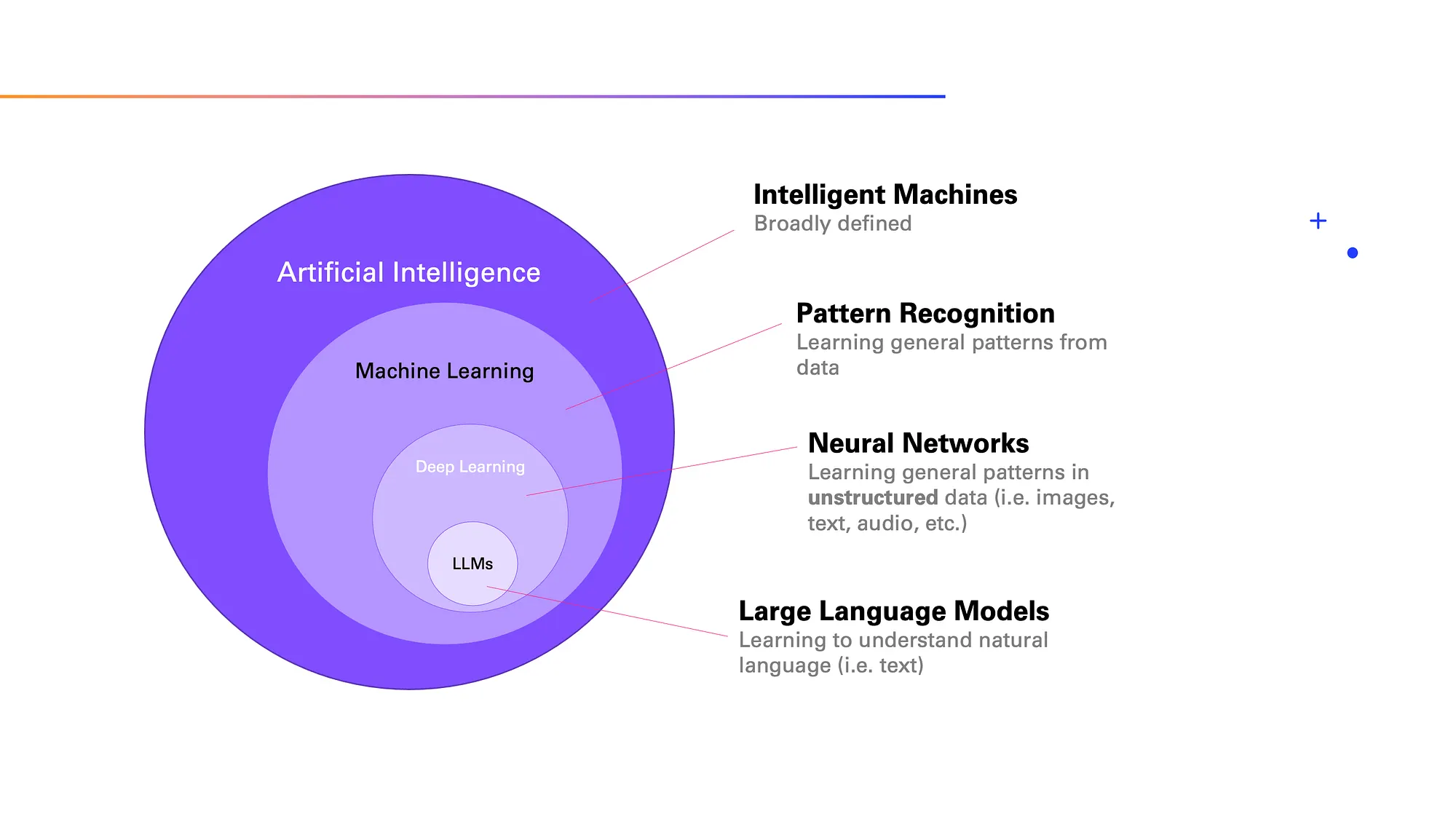
The field of AI is often visualized in layers:
- Artificial Intelligence (AI) is very a broad term, but generally it deals with intelligent machines.
- Machine Learning (ML) is a subfield of AI that specifically focuses on pattern recognition in data. As you can imagine, once you recoginze a pattern, you can apply that pattern to new observations. That’s the essence of the idea, but we will get to that in just a bit.
- Deep Learning is the field within ML that is focused on unstructured data, which includes text and images. It relies on artificial neural networks, a method that is (loosely) inspired by the human brain.
- Large Language Models (LLMs) deal with text specifically, and that will be the focus of this article.
As we go, we’ll pick up the relevant pieces from each of those layers. We’ll skip only the most outer one, Artificial Intelligence (as it is too general anyway) and head straight into what is Machine Learning.
The goal of Machine Learning is to discover patterns in data. Or more specifically, a pattern that describes the relationship between an input and an outcome. This is best explained using an example.
Let’s say we would like to distinguish between two of my favorite genres of music: reggaeton and R&B. If you are not familiar with those genres, here’s a very quick intro that will help us understand the task. Reggaeton is a Latin urban genre known for its lively beats and danceable rhythms, while R&B (Rhythm and Blues) is a genre rooted in African-American musical traditions, characterized by soulful vocals and a mix of upbeat and slower-paced songs.
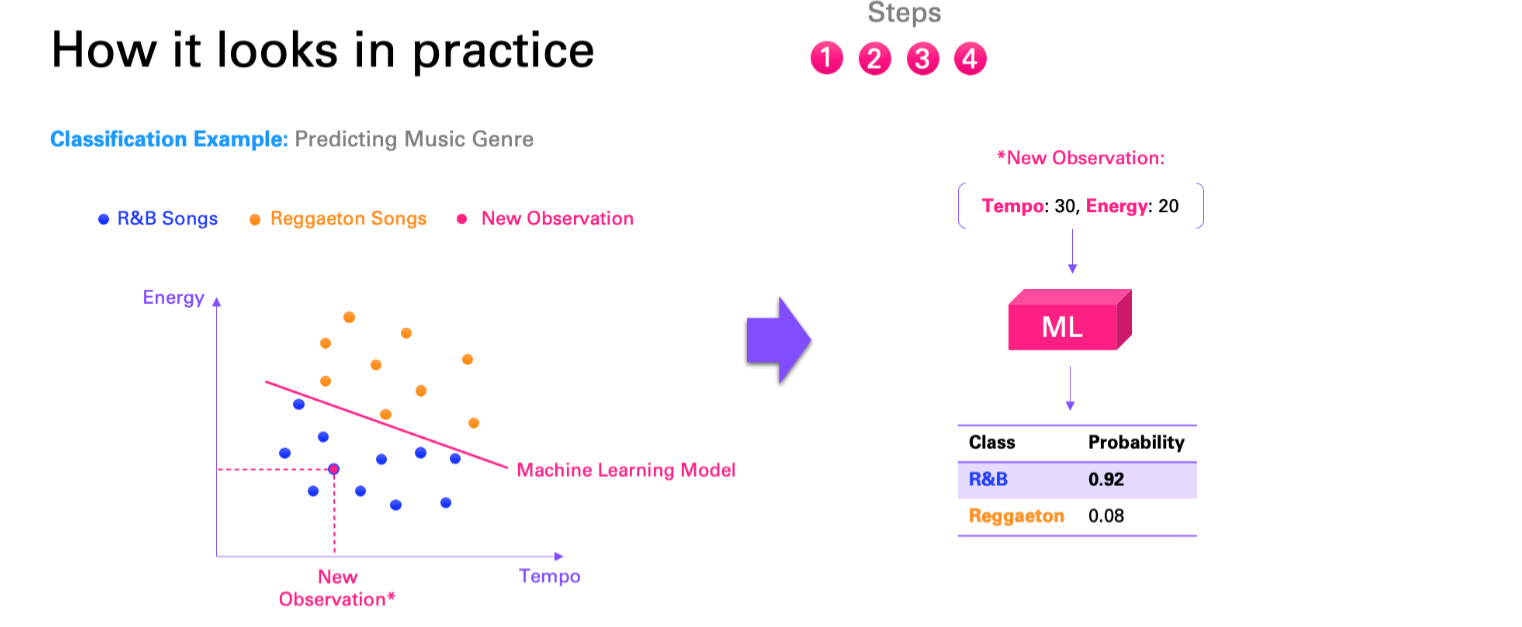
Suppose we have 20 songs. We know each song’s tempo and energy, two metrics that can be simply measured or computed for any song. In addition, we’ve labeled them with a genre, either reggaeton or R&B. When we visualize the data, we can see that high energy, high tempo songs are primarily reggaeton while lower tempo, lower energy songs are mostly R&B, which makes sense.
However, we want to avoid having to label the genre by hand all the time because it’s time consuming and not scalable. Instead, we can learn the relationship between the song metrics (tempo, energy) and genre and then make predictions using only the readily available metrics.
In Machine Learning terms, we say that this is a classification problem, because the outcome variable (the genre) can only take on one of a fixed set of classes/labels — here reggaeton and R&B. This is in contrast to a regression problem, where the outcome is a continuous value (e.g., a temperature or a distance).
We can now “train” a Machine Learning model (or “classifier”) using our labeled dataset, i.e., using a set of songs for which we do know the genre. Visually speaking, what the training of the model does here is that it finds the line that best separates the two classes.
How is that useful? Well, now that we know this line, for any new song we can make a prediction about whether it’s a reggaeton or an R&B song, depending on which side of the line the song falls on. All we need is the tempo and energy, which we assumed is more easily available. That is much simpler and scalable than have a human assign the genre for each and every song.
Additionally, as you can imagine, the further away from the line, the more certain we can be about being correct. Therefore, we can often also make a statement on how confident we are that a prediction is correct based on the distance from the line. For example, for our new low-energy, low-tempo song we might be 98 percent certain that this is an R&B song, with a two percent likelihood that it’s actually reggaeton.
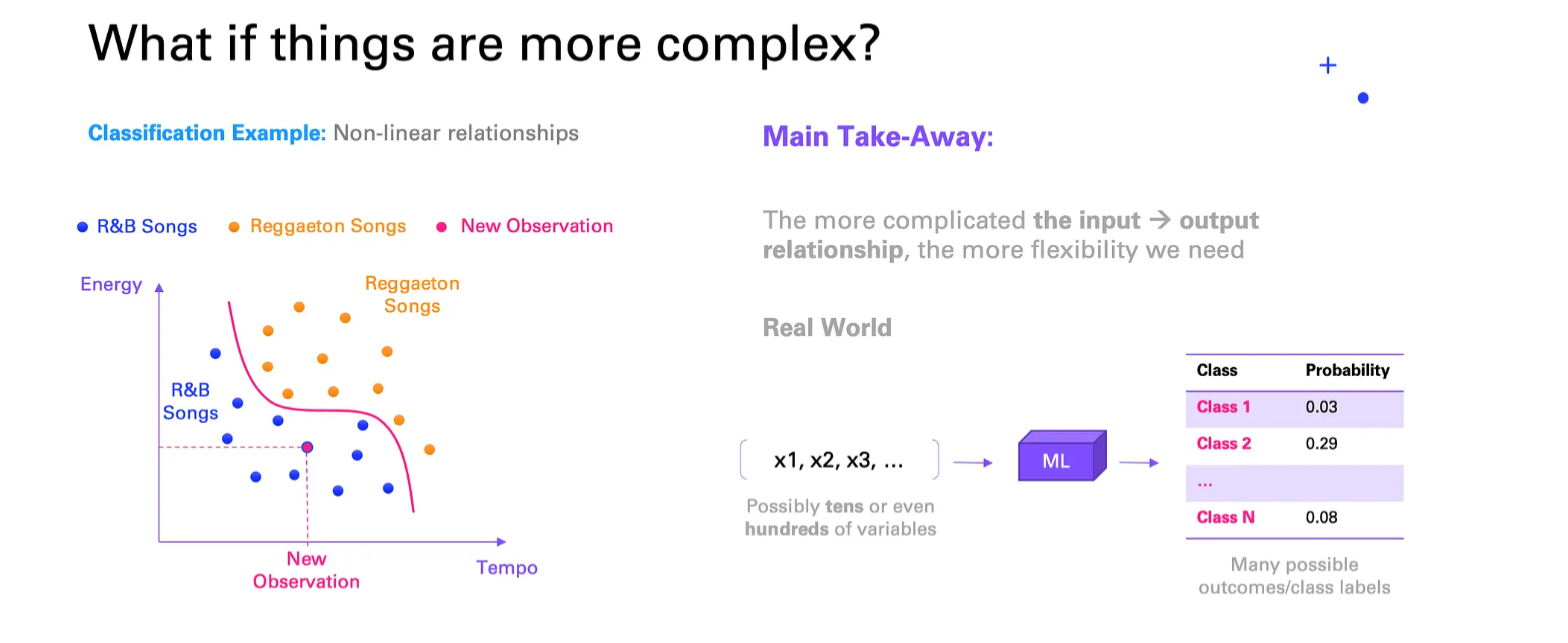
The best boundary to separate the classes may not be linear. In other words, the relationship between the inputs and the outcome can be more complex. It may be curved as in the image above, or even many times more complex than that.
Reality is typically more complex in another way too. Rather than only two inputs as in our example, we often have tens, hundreds, or even thousands of input variables. In addition, we often have more than two classes. And all classes can depend on all these inputs through an incredibly complex, non-linear relationship.
Even with our example, we know that in reality there are more than two genres, and we need many more metrics other than tempo and energy. The relationship among them is probably not so simple either.
What I mainly want you to take away is this: The more complex the relationship between input and output, the more complex and powerful is the Machine Learning model we need in order to learn that relationship. Usually, the complexity increases with the number of inputs and the number of classes.